 Rules
RulesThe prop-firm rules that quietly fail most traders
Daily loss limits, trailing drawdown, consistency rules and payout conditions — the four clauses worth reading twice.
 Prop Firms
A prop firm gives you capital to trade against a rulebook. The fee is small; the rules are what decide whether you ever get paid. This is how the model actually works — and when it makes sense for you.
by xStarRiverFebruary 18, 2026- 8 min read
A futures prop firm gives you a funded or simulated account and pays you a share of the profit if you trade inside its rules. You pay an evaluation fee to start. In exchange you get access to size you probably could not fund yourself, and the firm keeps a percentage of what you make.
That is the whole idea. Everything else — the profit targets, the drawdown limits, the consistency checks, the payout schedule — exists to make sure the firm is not exposed to someone who is simply gambling with its capital.
Your fee buys an evaluation attempt, not a funded account. Most people who pay never reach a payout, and that is not a conspiracy — it is the arithmetic of leverage plus a rulebook that punishes impulse.
The firms that survive are the ones that keep their rules stable and pay on time. When you compare firms, compare the boring parts: what counts toward the drawdown, whether the limit trails your equity, how long a payout takes, and what happens to your account after a withdrawal.
Paid per attempt. Treat it as the price of a course, not a deposit.
Usually 80–90% to you. Read the payout cycle before you count on it.
These decide most outcomes. They are covered in the next article.
Do not ask whether you can pass. Ask whether your current process survives a losing week without breaking a single rule. If the honest answer is no, the fee is not the problem — the process is, and a funded account will only make the flaw more expensive.
If the answer is yes, a prop firm is one of the cheapest ways to trade real size while you build a track record.
The evaluation is not a test of how much you can make. It is a test of how little you can lose without breaking the rules.
RulesDaily loss limits, trailing drawdown, consistency rules and payout conditions — the four clauses worth reading twice.
 Method
The method is not about predicting direction. It is about defining the area where you have an edge — and doing nothing everywhere else.
 Process
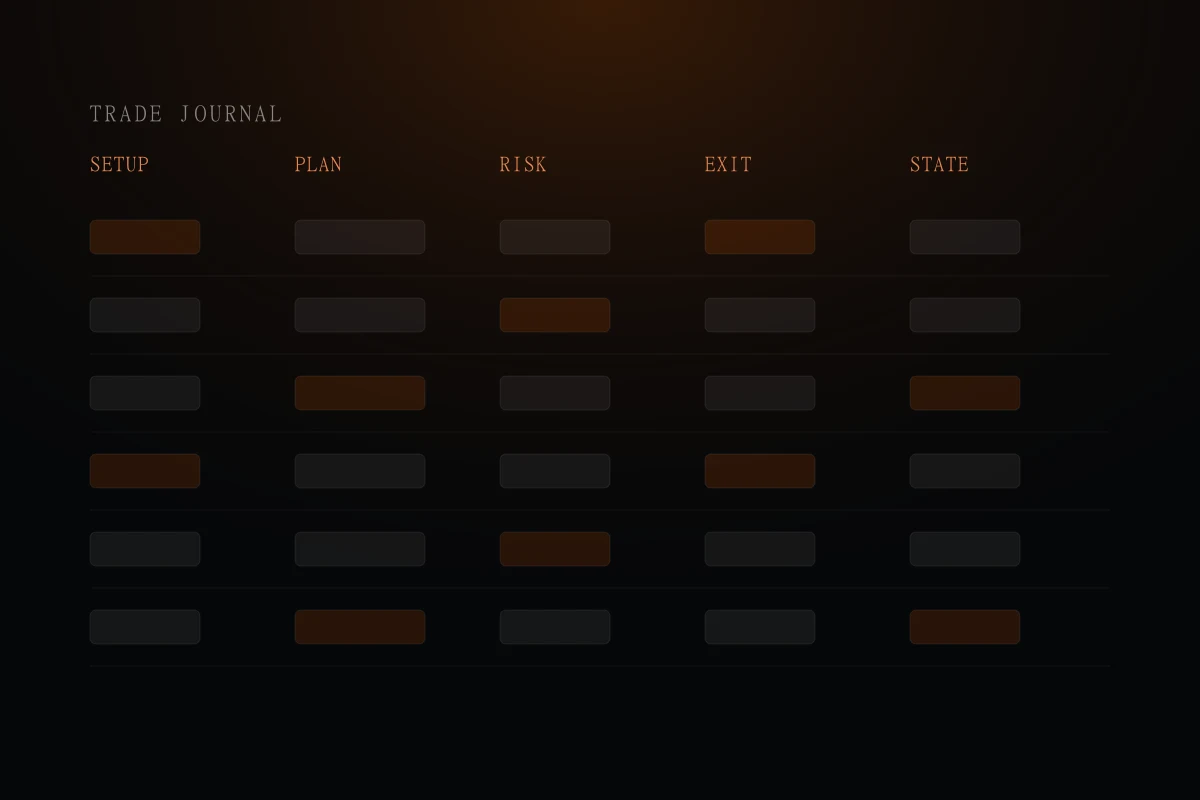
Most journals are diaries. Five fields turn yours into a feedback loop you can act on.